
◆
Directly stimulates dermal papilla cells — the master regulators at the base of each hair follicle — while protecting them from programmed cell death.
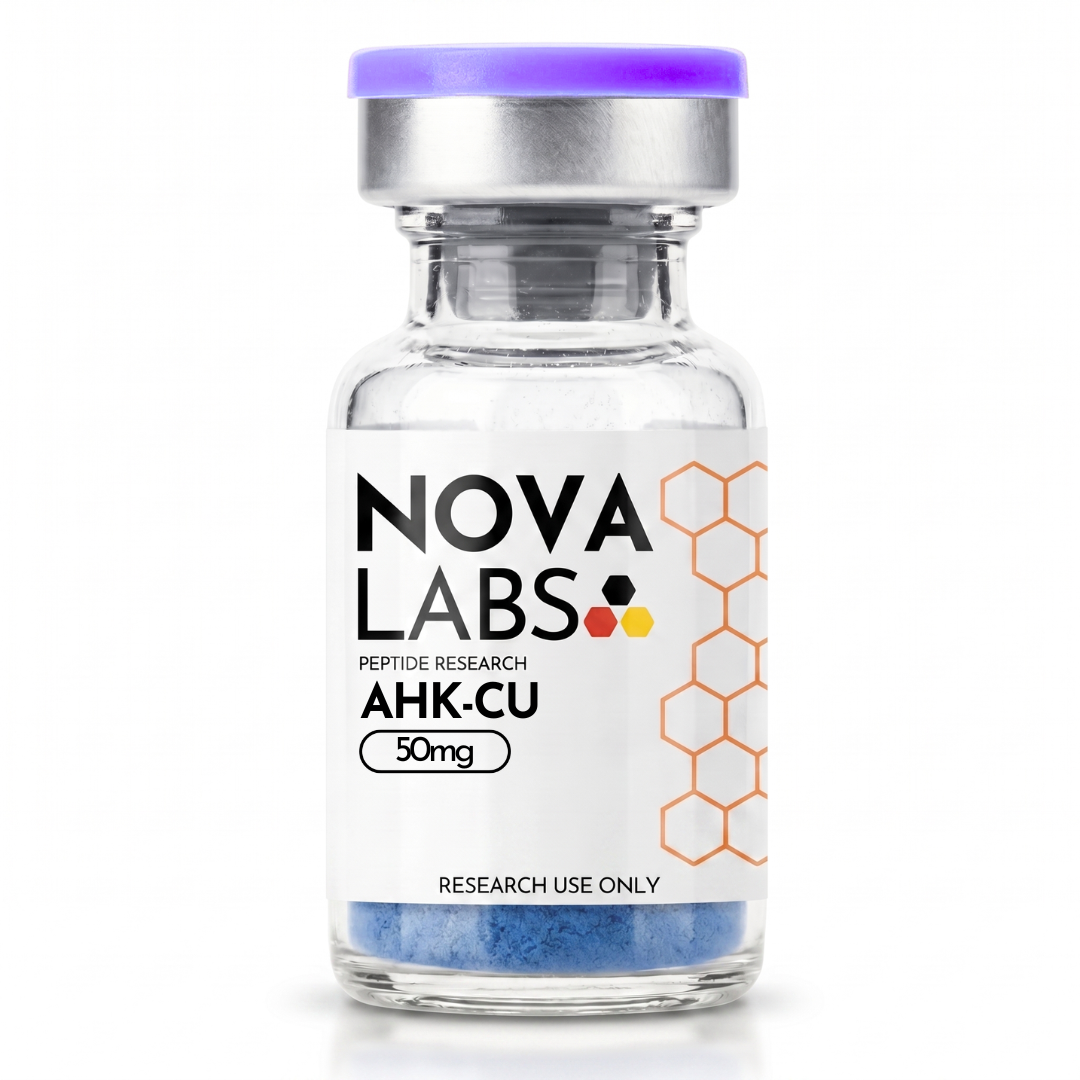
Dose ranges reflect commonly studied amounts in published research models. This is not medical advice. For research use only. Not for human consumption.
Protocol Comparison
Skin & Hair
Research dose range
Standard research range
1 - 2 mg
The primary working range for consistent follicle support.
Research focus
Hair follicle stimulation
Observed window
4-8 week active cycles
Administration
Once daily
Primary pathway
Dermal papilla cells (DPC), VEGF, TGF-β1
All dosing figures are extrapolated from GHK-Cu community protocols (a structurally related compound differing by one amino acid) — no AHK-Cu-specific injectable data exists, published or community-sourced. No human clinical trial supports injectable administration of either compound. For research use only.
MANFAAT PROTOKOL
◆
Directly stimulates dermal papilla cells — the master regulators at the base of each hair follicle — while protecting them from programmed cell death.
◆
Increases VEGF to improve blood supply to follicles, while suppressing TGF-β1, the signal that pushes follicles prematurely out of the growth phase.
◆
One amino acid swap from GHK-Cu redirects the entire effect — trading broad tissue repair for a mechanism concentrated specifically on the follicle microenvironment.
SAINS
AHK-Cu is a copper tripeptide — alanine, histidine, lysine, bound to copper — differing from its sister peptide GHK-Cu by a single amino acid substitution. That one change redirects the biology: instead of GHK-Cu's broad tissue-remodeling activity, AHK-Cu concentrates specifically on dermal papilla cells, the fibroblasts controlling each follicle's growth cycle.
The mechanism data comes from Seoul National University's ex vivo and in vitro research, not a human injectable trial — AHK-Cu increased VEGF, suppressed TGF-β1, and cut two separate cell-death markers by 43% and 78% at very low concentrations. Systemic delivery via injection follows the pattern set by its sister compound GHK-Cu, which research communities have used subcutaneously for years to extend copper-peptide signaling beyond the skin's surface — though neither compound has a published human trial confirming an optimal injectable protocol.
YANG DIHARAPKAN
Effects build on the hair growth cycle's own timeline, not overnight — anagen, the active growth phase, runs 2-7 years regardless of intervention. Community-cited injectable cycles for this compound class run 4-8 weeks active, followed by a break before resuming.
CATATAN PROTOKOL
Available in 50mg. For research use only. Full documentation included with every order.
FAQ
A single amino acid substitution — alanine in place of glycine — shifts AHK-Cu's mechanism away from GHK-Cu's broad tissue-repair activity and concentrates it specifically on dermal papilla cells at the hair follicle.
No AHK-Cu-specific injectable dosing data exists — published or community-sourced. The figures here are extrapolated from GHK-Cu's community SC protocol, the closest structural analog available.