
◆
KPV directly suppresses NF-kB, the master switch driving inflammatory signaling — the piece that separates this blend from GLOW, its three-peptide predecessor.
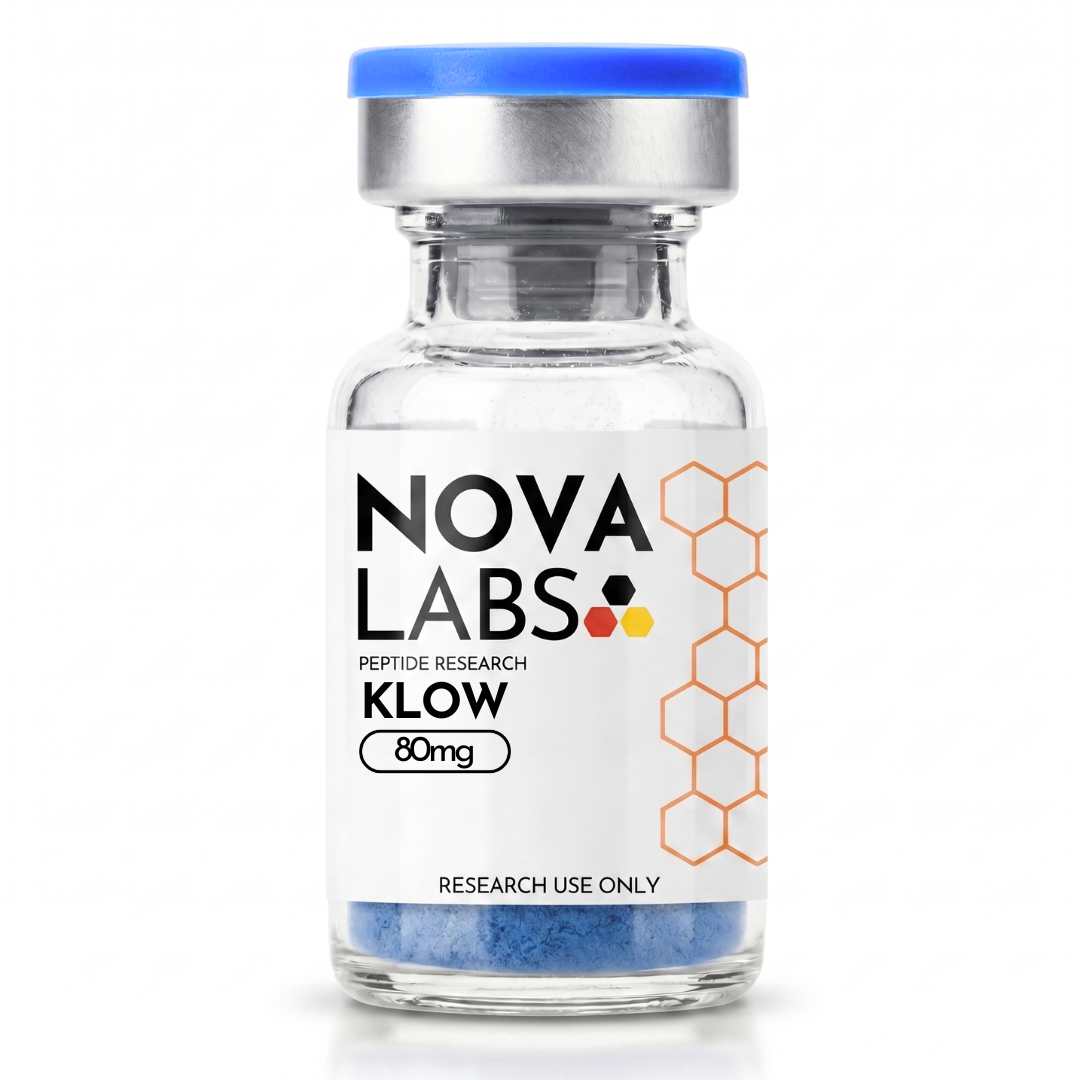
Dose ranges reflect commonly studied amounts in published research models. This is not medical advice. For research use only. Not for human consumption.
Protocol Comparison
Recovery
Research dose range
Standard research range
3 - 5 mg
"Active injury recovery" range (20-30 units) — BPC-157 and TB-500 begin exceeding their typical solo ranges here.
Research focus
Multi-pathway tissue repair, inflammation control, skin remodeling
Observed window
Skin/inflammation changes within a few weeks; tissue-repair benefits build over 4-8 weeks
Administration
Daily or 5x/week
Primary pathway
Collagen/ECM remodeling (GHK-Cu), NF-kB suppression (KPV), G-actin sequestration (TB-500), VEGF/Angiogenesis (BPC-157)
Mechanism references: Pickart & Margolina, 2018 (GHK-Cu); Grant et al., 1999 (TB-500); Vasireddi et al. and Lee & Burgess, 2025 (BPC-157). No verified primary citation exists for KPV's mechanism. The blend ratio and dosing schedule reflect vendor/community convention only — no peer-reviewed source has tested this combination. For research use only.
MANFAAT PROTOKOL
◆
KPV directly suppresses NF-kB, the master switch driving inflammatory signaling — the piece that separates this blend from GLOW, its three-peptide predecessor.
◆
GHK-Cu drives collagen synthesis and extracellular matrix remodeling, at nearly two-thirds of this blend's total mass — the anchor compound the other three build around.
◆
BPC-157 and TB-500 add local and systemic tissue repair on top — the same complementary pairing behind the Wolverine Blend, now folded into a four-compound stack.
SAINS
KLOW is built on a fixed 5:1:1:1 ratio — 50mg GHK-Cu to 10mg each of KPV, BPC-157, and TB-500 — a specific mass balance the research community converged on, not an arbitrary split. GHK-Cu anchors the blend, driving skin and connective-tissue remodeling; the other three each target a different bottleneck in the repair cascade — inflammation, blood flow, and cell migration.
What makes KLOW work as a stack is coverage — GHK-Cu remodels the extracellular matrix, KPV calms the inflammatory signal getting in its way, and BPC-157 and TB-500 keep blood flow and cell migration moving toward the site. Four mechanisms, four bottlenecks, one injection instead of four.
YANG DIHARAPKAN
Improved skin quality and reduced inflammation — are typically noted within the first few weeks. Deeper tissue-repair benefits from the BPC-157/TB-500 pairing build over a longer 4-8 week window, consistent with those compounds individually.
CATATAN PROTOKOL
50mg GHK-Cu + 10mg KPV + 10mg TB-500 + 10mg BPC-157 per vial (5:1:1:1 ratio). For research use only. Full documentation included with every order.
FAQ
KLOW adds KPV, a tripeptide that directly suppresses NF-kB inflammatory signaling — GLOW has the same GHK-Cu, BPC-157, and TB-500 base without that fourth anti-inflammatory component.
Not exactly — see the note below the dose table. At higher blend doses, GHK-Cu and BPC-157 can exceed their typical standalone ranges, since all four components scale together at a fixed ratio.
PRODUK TERKAIT