
◆
BPC-157 drives localized repair at the injury site — collagen synthesis, blood vessel growth, inflammation control exactly where it's needed.
Dose ranges reflect commonly studied amounts in published research models. This is not medical advice. For research use only. Not for human consumption.
Protocol Comparison
Recovery
Research dose range
Standard research range
250 - 350 mcg
BPC-157's most frequently cited working range. Co-delivers 250-350mcg TB-500 — still a fraction of its standalone 1-6mg range.
Research focus
Dual-pathway tissue repair (local + systemic)
Observed window
2-4 weeks early signal; 6-8 weeks structural remodeling
Administration
2x/week
Primary pathway
VEGF / Nitric Oxide / GH receptor (BPC-157); G-actin sequestration / VEGF (TB-500)
BPC-157 dosing anchored to research-protocol summaries. TB-500 co-dose at this vial's fixed 1:1 ratio falls well under TB-500's typical standalone range at every tier — no combined-ratio trial exists for this specific pairing. For research use only.
MANFAAT PROTOKOL
◆
BPC-157 drives localized repair at the injury site — collagen synthesis, blood vessel growth, inflammation control exactly where it's needed.
◆
TB-500 works systemically — sequestering G-actin to keep cells primed for migration toward damaged tissue, wherever it is in the body.
◆
Two distinct mechanisms converging on the same outcome — repair driven from the injury site and from the bloodstream at once.
SAINS
BPC-157 and TB-500 take different routes to the same destination. BPC-157 acts locally — a stable, enzyme-resistant peptide that drives new blood vessel growth and collagen synthesis right at the site of injury. TB-500 works at a distance — the active fragment of Thymosin Beta-4, sequestering G-actin to keep cells primed for migration toward damage anywhere in the body.
TB-500 carries a specific evidence gap worth knowing: most human safety and mechanism data — including completed Phase I/II trials — used the full 43-amino-acid Thymosin Beta-4 protein, not the 7-amino-acid fragment sold here. Whether the fragment reproduces the parent protein's full effect at typical doses isn't settled. BPC-157's evidence has a similar shape — animal data is extensive and consistent, human data is limited to small pilot studies.
YANG DIHARAPKAN
Early anti-inflammatory signals are commonly reported within 2-4 weeks. Broader structural remodeling — the effect TB-500's systemic reach and BPC-157's local repair are meant to combine on — builds progressively over 6-8 weeks.
CATATAN PROTOKOL
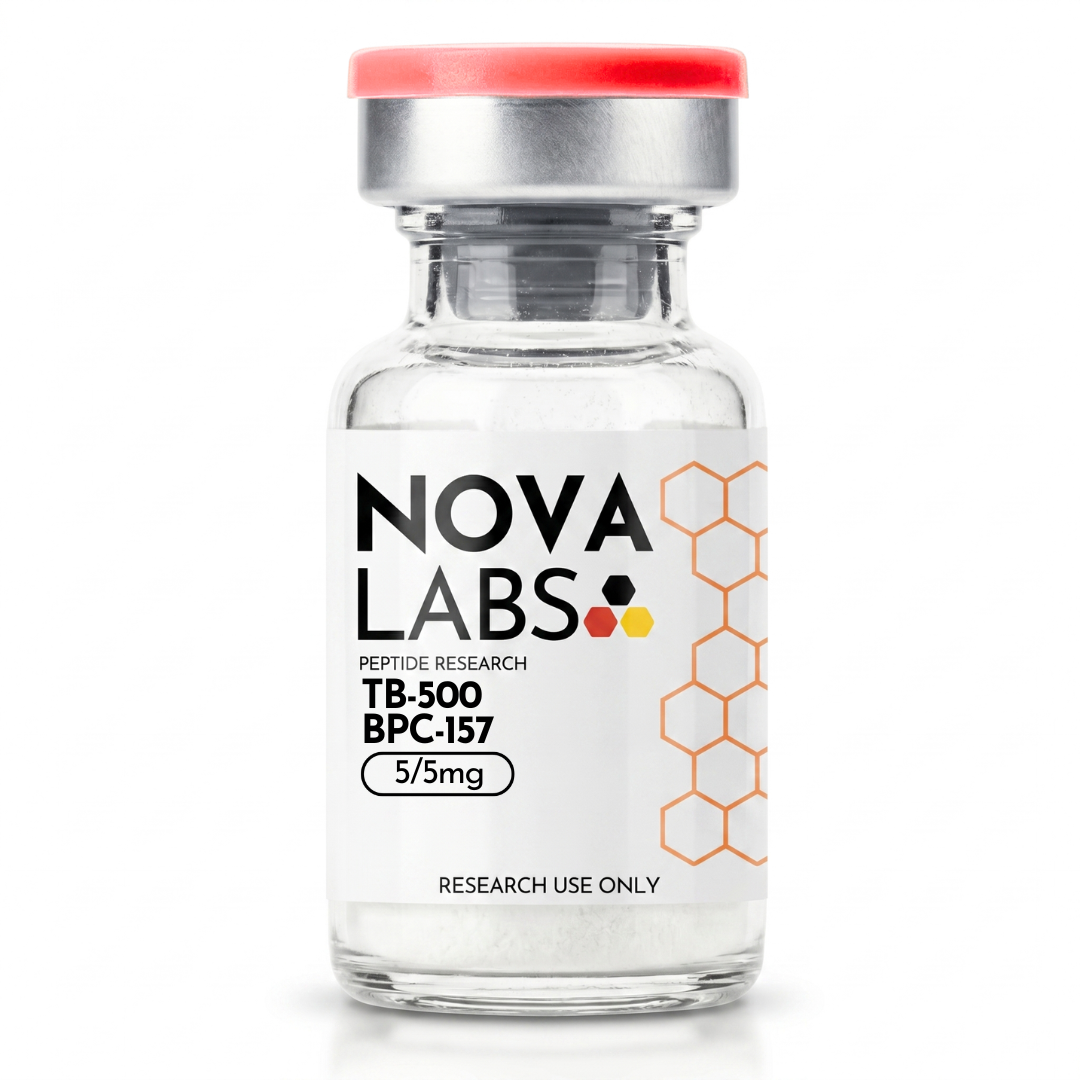
5mg BPC-157 + 5mg TB-500 per vial. For research use only. Full documentation included with every order.
FAQ
BPC-157 and TB-500 work through genuinely different mechanisms — one local, one systemic — targeting repair from two directions rather than duplicating the same pathway.
No. See the note below the dose table before treating this as two normally-dosed compounds in one vial.